
Going the extra mile to understand and serve Georgia
New Faculty Tour introduces participants to the state and the impact of the University of Georgia
On the first morning of the 2026 New Faculty Tour, participants were asked what they hoped to learn from the week. They were seeking answers ranging from understanding the needs of Georgia and finding interdisciplinary collaborators to learning where their students come from and identifying new opportunities to serve communities through their teaching and research. Over five days and hundreds of miles, Georgia began answering those questions for them.
The New Faculty Tour is designed to introduce faculty to Georgia’s geography, demographics, economy, history and culture while familiarizing them with UGA’s land-grant and sea-grant missions and longstanding commitment to serving the state. Coordinated by UGA Public Service and Outreach, the immersive experience takes faculty beyond Athens to meet the people and visit the communities, industries and landscapes shaping Georgia.
This year, faculty traveled through 53 counties and 87 cities, experiencing a state that ranges from coastal ecosystems and one of the nation’s busiest ports to agricultural operations, rural communities, Metro Atlanta and the mountains of north Georgia.

As New Faculty Tour participants prepare to set out across Georgia, Vice President for Public Service and Outreach Stacy Jones and Vice Provost for Academic Affairs Elizabeth Weeks visit with them prior to send-off. Over five days and hundreds of miles, faculty traveled through 53 counties and 87 cities to better understand the state, build connections and explore how their teaching, research and service can benefit Georgia.
As New Faculty Tour participants prepare to set out across Georgia, Vice President for Public Service and Outreach Stacy Jones and Vice Provost for Academic Affairs Elizabeth Weeks visit with them prior to send-off. Over five days and hundreds of miles, faculty traveled through 53 counties and 87 cities to better understand the state, build connections and explore how their teaching, research and service can benefit Georgia.

Faculty explore precision agriculture technologies at the UGA Tifton campus, one of several stops where participants saw how university research and Cooperative Extension work together to address challenges facing Georgia agriculture and put new knowledge into the hands of producers.
Faculty explore precision agriculture technologies at the UGA Tifton campus, one of several stops where participants saw how university research and Cooperative Extension work together to address challenges facing Georgia agriculture and put new knowledge into the hands of producers.

Throughout the tour, faculty learned how UGA’s eight Public Service and Outreach units connect university expertise with communities across the state, and how those resources can support their own teaching, research and service. Here, tour participants Celeste Rivenbark, left, and Lauren Lazaro listen to education director Cora Keber talk about the work of the State Botanical Garden of Georgia at the University of Georgia.
Throughout the tour, faculty learned how UGA’s eight Public Service and Outreach units connect university expertise with communities across the state, and how those resources can support their own teaching, research and service. Here, tour participants Celeste Rivenbark, left, and Lauren Lazaro listen to education director Cora Keber talk about the work of the State Botanical Garden of Georgia at the University of Georgia.
“The New Faculty Tour gives faculty an opportunity early in their UGA careers to understand the state and the people our university serves,” said Stacy Jones, vice president for public service and outreach. “When faculty see Georgia firsthand and hear directly from community, business and civic leaders, they begin to see new connections between their expertise and the opportunities and challenges facing our state. Those relationships can shape their teaching, research and service for years to come.”
Faculty got a closer look at the economic development ecosystem at Georgia Power's corporate office in Atlanta. Jason Dunn from the Fitzgerald-Ben Hill County Development Authority, Heath Tippens from the Cherokee County Office of Economic Development, Elyse Davis from Georgia Power and Greg Wilson from the Carl Vinson Institute of Government shared collaboration impacts for Georgia with Asher Dozier, acting UGA Economic Development director.
Faculty got a closer look at the economic development ecosystem at Georgia Power's corporate office in Atlanta. Jason Dunn from the Fitzgerald-Ben Hill County Development Authority, Heath Tippens from the Cherokee County Office of Economic Development, Elyse Davis from Georgia Power and Greg Wilson from the Carl Vinson Institute of Government shared collaboration impacts for Georgia with Asher Dozier, acting UGA Economic Development director.
Throughout the week, faculty saw those relationships in action. They learned how UGA Cooperative Extension brings research to farmers and families, how the Archway Partnership works alongside communities on locally-identified priorities, and how university partnerships with organizations such as Georgia Power and the Georgia Ports Authority support industries critical to the state’s economy.
Just as important, they heard directly from Georgians about what UGA’s presence means to their communities. In Macon, Kathryn Dennis, president of the Community Foundation of Central Georgia, offered a simple assessment:
“We are better off as a state and community because of UGA’s reach and support.”
For many participants, seeing that reach firsthand changed their understanding of the university they had joined.
Brandon Charles, who is new to both UGA and Georgia, said the experience revealed a side of the university he hadn’t fully understood.
Charles, an assistant professor of public administration and policy at the School of Public and International Affairs, was familiar with UGA’s land-grant mission before joining the university, but the tour showed him “just how deeply UGA is integrated into the community” across the state and how communities view the university as an essential partner.
"I saw how connected we are to every community across Georgia and how we can play a role and really listen and also help in any way these communities need and bridge that academic and community relationship, which is what my research is all about."
Jennifer Duck, clinical associate professor, Grady College of Journalism and Mass Communication
The tour also connects faculty with one another.
Nick Bradley, an economic impact specialist for UGA Extension, returned with an even longer list. By the end of the week, he was considering research with a pharmacy faculty member focused on rural communities, inviting another new colleague to contribute to one of his courses and exploring opportunities to analyze the economic impact of work happening elsewhere at UGA.
Those connections can reach students as well.
LaTonya Taylor, an assistant professor of public relations at the Grady College of Journalism and Mass Communication, said people she met during the tour offered to speak with her public relations students, help identify experiential learning opportunities and potentially participate in her research.
“I realized how many people are available to be a resource not only for my research, but also to my students,” Taylor said.
Five days after setting out to better understand Georgia, faculty returned to Athens with more than a sense of the state’s geography, industries and communities. They returned with new collaborators, community connections and ideas for how their teaching, research and service can contribute to the state they now serve.
"The biggest takeaway was really seeing the relationships and all of the trust that has to be built between the university and these communities in order to turn these projects into successes."
Cameron Thomas, assistant professor, College of Pharmacy
Amanda Fishman, director of parent and family engagement in the Office of Student Affairs, outside the Georgia Center for Continuing Education & Hotel.
Amanda Fishman, director of parent and family engagement in the Office of Student Affairs, outside the Georgia Center for Continuing Education & Hotel.
Vidalia onions at Bland Farms in Glennville.
Vidalia onions at Bland Farms in Glennville.
Leader of New Faculty Tour, Matt Bishop, associate vice president for public service and outreach, shares a farewell with Glenn Jackson from the College of Veterinary Medicine.
Leader of New Faculty Tour, Matt Bishop, associate vice president for public service and outreach, shares a farewell with Glenn Jackson from the College of Veterinary Medicine.
Faculty tour the Hart County Community Theatre in Hartwell.
Faculty tour the Hart County Community Theatre in Hartwell.
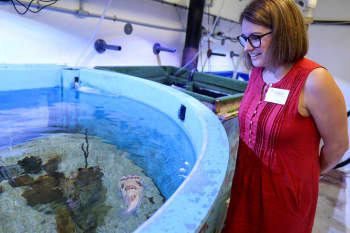
Celeste Rivenbark, marine educator at Marine Extension and Georgia Sea Grant, Neel Aziz, associate professor in the College of Veterinary Medicine, and Lauren Lazaro, Extension precision ag specialist, look at snakes at the UGA Aquarium on Skidaway Island.
Celeste Rivenbark, marine educator at Marine Extension and Georgia Sea Grant, Neel Aziz, associate professor in the College of Veterinary Medicine, and Lauren Lazaro, Extension precision ag specialist, look at snakes at the UGA Aquarium on Skidaway Island.
The 2026 New Faculty Tour participants with Elizabeth Weeks, vice provost for academic affairs, Stacy Jones, vice president for public service and outreach, and Hairy Dawg at the Georgia Center for Continuing Education & Hotel.
The 2026 New Faculty Tour participants with Elizabeth Weeks, vice provost for academic affairs, Stacy Jones, vice president for public service and outreach, and Hairy Dawg at the Georgia Center for Continuing Education & Hotel.
Jonathan Shuster, owner of Shuster’s Candy and Creamery, speaks to faculty members about how the UGA Small Business Development Center helped his business at Capricorn Sound Studios in Macon.
Jonathan Shuster, owner of Shuster’s Candy and Creamery, speaks to faculty members about how the UGA Small Business Development Center helped his business at Capricorn Sound Studios in Macon.
Tracie Revis, director of the Ocmulgee National Park and Preserve Initiative, shares about this significant historical site.
Tracie Revis, director of the Ocmulgee National Park and Preserve Initiative, shares about this significant historical site.
Brendan Leahy, public service associate in the UGA J.W. Fanning Institute for Leadership Development, leads tour participants in a leadership exercise.
Brendan Leahy, public service associate in the UGA J.W. Fanning Institute for Leadership Development, leads tour participants in a leadership exercise.
Tao Liu, assistant professor in the Warnell School of Forestry and Natural Resources and Cameron Thomas, assistant professor in the College of Pharmacy look out the window during the tour of the Georgia Ports Authority Garden City Terminal in Garden City.
Tao Liu, assistant professor in the Warnell School of Forestry and Natural Resources and Cameron Thomas, assistant professor in the College of Pharmacy look out the window during the tour of the Georgia Ports Authority Garden City Terminal in Garden City.
Faculty volunteers learn about the Archway Partnership through a role-play activity in Thomson.
Faculty volunteers learn about the Archway Partnership through a role-play activity in Thomson.
Now in its 40th year, the New Faculty Tour has introduced nearly 1,680 faculty members to UGA’s statewide mission and helped spark research, teaching and partnerships that continue to benefit Georgia.
“It’s been a really unique opportunity to get to know the community that I’ll be serving in a way that I haven’t been able to in my previous position.”
The tour is coordinated by the Office of the Vice President for Public Service and Outreach and the J.W. Fanning Institute for Leadership Development and is made possible by support from the Office of the President, the Office of the Senior Vice President for Academic Affairs and Provost, and the Office of the Vice President for Public Service and Outreach.
Additional support comes from the UGA Foundation, UGA Alumni Association, College of Agricultural and Environmental Sciences and other units of the university.
This year’s cohort of 30 new faculty represented 16 schools and colleges, three Public Service and Outreach units, Student Affairs and the Office of Research.

Tour participants learn about muscadine grape production at Paulk Vineyards in Irwin County. Agricultural stops throughout the week introduced faculty to Georgia producers and demonstrated how research, Cooperative Extension and industry relationships support one of the state’s most important economic sectors.
Tour participants learn about muscadine grape production at Paulk Vineyards in Irwin County. Agricultural stops throughout the week introduced faculty to Georgia producers and demonstrated how research, Cooperative Extension and industry relationships support one of the state’s most important economic sectors.

Aaron Bivins, assistant professor in the College of Public Health with a dual appointment in the College of Engineering, and Aja Kennedy, an applied economist at the Carl Vinson Institute of Government, get a closer look at marine life at the UGA Aquarium during a stop at UGA Marine Extension and Georgia Sea Grant in Savannah. The visit introduced faculty to UGA’s sea-grant mission and the university’s work supporting Georgia’s coast, communities and marine ecosystems.
Aaron Bivins, assistant professor in the College of Public Health with a dual appointment in the College of Engineering, and Aja Kennedy, an applied economist at the Carl Vinson Institute of Government, get a closer look at marine life at the UGA Aquarium during a stop at UGA Marine Extension and Georgia Sea Grant in Savannah. The visit introduced faculty to UGA’s sea-grant mission and the university’s work supporting Georgia’s coast, communities and marine ecosystems.

Jennifer Duck, clinical associate professor in the Grady College of Journalism and Mass Communication, photographs Railroad Street Park during the tour’s stop in Hartwell. Visits with community leaders throughout the week showed faculty how listening, relationships and local partnerships help connect UGA resources with community priorities.
Jennifer Duck, clinical associate professor in the Grady College of Journalism and Mass Communication, photographs Railroad Street Park during the tour’s stop in Hartwell. Visits with community leaders throughout the week showed faculty how listening, relationships and local partnerships help connect UGA resources with community priorities.
Faculty Takeaways
Pedro Henrique Vilela Carvalho
College of Agricultural and Environmental Sciences
Smita Rawal
College of Pharmacy
LaTonya Taylor
Grady College of Journalism and Mass Communication
 Built with Shorthand